Why Do Renegades Love Ren? (Quick Answer)
Renegades – Ren’s devoted fanbase – love him because he articulates experiences most artists avoid: chronic illness, mental health struggles, medical trauma, and creative self-doubt. His unflinching honesty, combined with genuine musical virtuosity, creates work that doesn’t just entertain but validates deeply personal experiences many people carry in silence.
But as someone who spent 30 years as a mental health nurse and discovered Ren as a fan myself, I think there’s something more specific happening here. It’s not just the honesty – it’s that Ren gives people language for things that felt unspeakable. And then he builds a community where thousands of people discover they speak that same language.
Let me show you what I mean…
I First Heard Hi Ren and Everything Changed
I discovered Ren about two and a half years ago when someone posted Hi Ren in a Facebook group. I almost scrolled past it. I’m glad I didn’t.
I’ve been obsessed with music my whole life. Proper obsessed – the kind where you know the deep cuts, the B-sides, the stories behind the songs. But Hi Ren felt different. It felt like someone had taken everything I thought I knew about what a song could do and just… expanded it.
Eight minutes of one man, an acoustic guitar, and a conversation with the darkest parts of himself. No backing band. No production tricks. Just raw, unfiltered psychological warfare set to music. And it was extraordinary.
That’s when I started going down the rabbit hole. (If you know, you know.)
The Validation Nobody Else Provides
Here’s what I learned in my 30 years as a mental health nurse: most people struggling with chronic illness, mental health challenges, or medical trauma feel profoundly alone. Not because they don’t have people who care about them – they do. But because the specific experience of what they’re going through feels impossible to explain to someone who hasn’t lived it.
Ren doesn’t just acknowledge these experiences. He gives them shape, language, rhythm. He makes them real in a way that feels like permission to acknowledge your own reality.
Take Hi Ren. That’s not a metaphor about overcoming adversity or finding the light or whatever uplifting nonsense we’ve been sold. It’s psychological warfare. It’s the voice that says “you’re worthless” meeting the voice that’s desperately trying to create something meaningful. And it doesn’t resolve neatly – because that’s not how it works in real life.
Or Sick Boi, where Ren captures the rage and exhaustion of being chronically ill in a medical system that doesn’t have answers. “Sick boy, sick boy, bitten by a tick boy” – that’s not poetry, that’s his literal diagnosis and the years-long carousel of failed treatments that followed.
When you’ve spent years being told your symptoms are psychosomatic, or that you just need to think more positively, or that it can’t be that bad – hearing someone articulate the actual experience is validation on a level most people can’t comprehend.
Why This Matters Clinically
In mental health work, we talk about “bearing witness” – the therapeutic value of having someone truly see and acknowledge your experience without trying to fix it or minimize it. That’s what Ren’s music does. He bears witness to experiences that most artists wouldn’t touch because they’re too uncomfortable, too messy, too real.
And for people who’ve felt invisible in their struggle – whether that’s chronic illness, mental health challenges, creative self-doubt, or all of the above – that validation is profound.
Honesty Without Exploitation
Here’s the thing that makes Ren different from other artists who tackle difficult subjects: he’s not using trauma for content. He’s processing it through art.
There’s a distinction that matters. Trauma-as-content feels performative – it’s designed to shock or garner sympathy or get clicks. You can feel the artist’s distance from it, like they’re presenting their pain for consumption.
Ren’s work doesn’t feel like that. In Hi Ren, when he’s switching between voices – the dark Ren who’s manipulative and patient and knows exactly where to strike, and the light Ren who’s trying to set boundaries and protect himself – you’re not watching a performance of mental health struggle. You’re watching someone genuinely work through something in real time.
I spent 30 years sitting in therapy rooms. I know the difference between someone performing distress and someone genuinely in it. Ren’s work has the hallmarks of genuine processing – the contradictions, the complexity, the lack of neat resolution.
That authenticity is what makes Renegades so fiercely protective of him. We’re not consuming his trauma. We’re witnessing his artistry in transforming it into something that helps us understand our own experiences.
The Music Matches the Message
Let’s be clear about something: Ren isn’t popular just because he’s honest about difficult topics. He’s popular because he’s genuinely, extraordinarily talented.
The technical skill is undeniable. In Hi Ren alone, you’ve got:
- Lyrics on par with Dylan
- Acoustic guitar skills like John Williams
- Rap flow like Eminem
- A voice that shifts from angel to demon, sometimes in the same breath
- Composition that holds you for eight minutes without a backing band
This matters because it proves the work isn’t just “venting.” It’s craft. It’s artistry. The dark voice in Hi Ren goes straight for the creative insecurity: “Man, you’re not original, you criminal, rip-off artist. The pinnacle of your success is stealing from other people’s material.”
And then Ren fights back: “My music is really connecting, and the people who find it respect it. And for me, that’s enough ’cause this life’s been tough.”
That’s not bravado. That’s someone holding onto the one thing that makes sense when everything else has fallen apart. The music is the record – the body keeps the minutes; the songs keep the meaning.
The technical excellence validates the message. It says: this isn’t just therapeutic processing (though it is that). It’s art that stands on its own merit.
He Names What Feels Unspeakable
In mental health work, one of the most powerful moments is when someone finds language for an experience they thought was uniquely theirs – and discovers it’s actually shared by many people.
Ren does this consistently. He articulates internal experiences that most people have never heard expressed out loud:
The internal dialogue of chronic illness. The way medical trauma changes how you relate to your own body. The experience of being treated for the wrong conditions while the real problem goes unrecognised. The creative self-doubt that feels like a separate entity living in your head. The exhaustion of managing other people’s discomfort with your illness.
When I first heard that line in Hi Ren – “You’re the sheep, I’m the shepherd, not your place to lead me” – I sat back and thought: I sat in crisis interventions where people described their internal dialogue in exactly those terms. The voice that feels separate, more powerful, more knowing. The struggle to maintain boundaries with parts of yourself.
But I’d never heard it in a song before. And I’d certainly never heard it expressed so precisely.
For people experiencing these things, hearing them named – really named, not euphemised or sanitised – is like someone turning on a light in a room you thought you were navigating alone.
The Community That Ren Built
I used to help admin REN’s Rabbit Hole Fans, a Facebook community of over 63,000 Renegades. Life got complicated – my dad has dementia, and I didn’t have the time to devote to the role properly anymore. But my time in that community showed me something I need to share, because it connects directly to why Ren’s music matters so much.
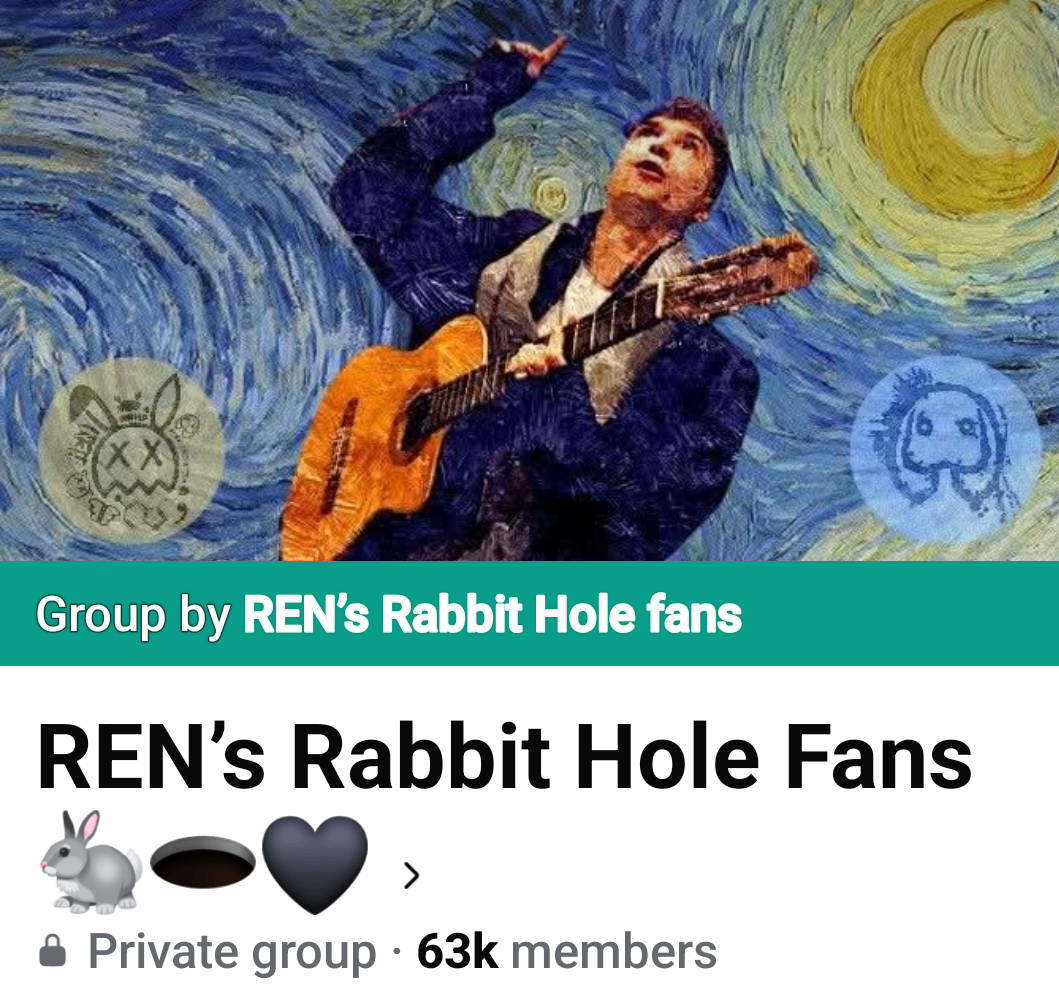
Here’s what’s interesting: the Rabbit Hole isn’t a mental health support group. We deliberately kept MH posts off the main page – the focus is celebrating Ren’s music, sharing discoveries, discussing his artistry. But despite that – or maybe because of it – the community is remarkably kind and supportive.
When someone shares excitement about a lyric they finally understood, posts footage from one of The Big Push’s busking sessions, discusses a new track, or just contributes to the conversation, there’s genuine warmth. No performative sympathy, no trauma dumping, just people who understand each other connecting over music that matters to them.
In my 30 years as a mental health nurse, I saw how powerful it is when people gather around something positive rather than making struggle the centerpiece. The Rabbit Hole does that. It’s a space to celebrate art that validates difficult experiences – without making those experiences the focus. That’s a subtle but important distinction.
Why the Community Itself Matters
It’s one thing to feel understood by an artist. It’s another thing entirely to discover thousands of people who speak that same language.
The Renegade community doesn’t just consume Ren’s music – they engage with it deeply. People analyze lyrics, discuss symbolism, share how specific songs helped them through specific situations. The level of thoughtful engagement is extraordinary.
And here’s what I noticed as an admin: people are genuinely kind to each other. When someone asks a question that’s been asked a hundred times before, they get patient answers. When someone shares a personal connection to a song, they get respect, not exploitation. When disagreements happen, they’re generally handled with more maturity than most online spaces manage.
That reflects something about both the music and the people it attracts. Ren’s honesty and complexity seem to draw people who value those same qualities. People who’ve learned empathy through their own struggles. People who understand that there’s rarely one “right” interpretation.
Recovery Narrative Without Toxic Positivity
One of the things that makes Ren’s work sustainable – and why it builds such a devoted following – is that he doesn’t promise easy answers or complete healing.
In Genesis, he talks about recovery as rhythm, not revelation. The discipline that forged his voice and live craft through years of illness. The music is the record; the body keeps the minutes; the songs keep the meaning.
That’s a fundamentally different narrative than “I overcame my illness and now I’m cured and you can be too!” It’s honest about the ongoing nature of chronic illness management. It acknowledges that getting better isn’t always linear, isn’t always complete, and doesn’t erase what you went through.
This matters enormously to people living with chronic conditions. Most recovery narratives in popular culture follow a very specific arc: struggle → intervention → triumph → complete healing. Real life rarely works that way, especially with chronic illness or long-term mental health challenges.
Ren’s narrative is more like: struggle → misdiagnosis → worse struggle → eventually some answers → ongoing management → creating meaning from it all → still dealing with it but also making extraordinary art.
That’s real. That’s sustainable. That’s a narrative people can actually live with, rather than one that makes them feel like failures when they’re not “fully recovered.”
Why It Matters That He’s Still Here
There’s something profound about the fact that Ren made it through. Not in a sanitized “everything happens for a reason” way, but in the raw “I nearly didn’t make it and here’s what that looked like” way.
In Hi Ren, when the dark voice says “You thought you’d buried me, didn’t you? Risky” – that’s not metaphor. That’s someone who’s been close enough to not being here anymore to know exactly what that edge feels like.
And the fact that he’s turned that experience into art that helps other people? That’s genuine alchemy – transforming something devastating into something that creates meaning and connection.
For people in their own struggles – whether that’s chronic illness, mental health challenges, creative blocks, or just the general difficulty of being human – there’s power in seeing someone who went through hell and came out the other side making extraordinary work.
Not because it promises you’ll have the same outcome. But because it proves that meaning can be made from suffering. That your experience, however painful, isn’t wasted if you can transform it into something – art, understanding, connection, growth.
The Renegade Identity
Being a Renegade isn’t just about being a fan. It’s about recognizing yourself in the work and in the community around it.
Renegades tend to be people who:
- Appreciate unflinching honesty over comfortable platitudes
- Value technical excellence and artistic integrity
- Have experienced struggle and developed empathy from it
- Engage with art deeply rather than passively consuming it
- Understand that complexity and contradiction are part of being human
- Want community without performative trauma bonding
That’s a specific type of person. And when you find 63,000+ of them in one place, all connected through music that validates experiences many of them thought were uniquely isolating – that’s powerful.
The Renegade identity is about more than music fandom. It’s about finding your people through shared understanding, then choosing to build something positive around that shared experience rather than staying stuck in the struggle.
My Perspective as Both Nurse and Renegade
I need to be honest about something: my clinical background shapes how I hear Ren’s music, but it’s not why I love it.
I love it because it’s extraordinary art. Because Hi Ren is one of the most honest eight minutes in modern music. Because Sick Boi articulates rage I’ve felt but never heard expressed. Because Genesis captures something true about how recovery actually works.
The nursing background just helps me articulate *why* it works. Why the therapy room framing in Sick Boi is so effective. Why the personification of illness in Hi Ren resonates clinically. Why the Renegade community functions the way it does.
But first and foremost, I’m a fan. I went down the rabbit hole not because I saw therapeutic value (though I did), but because the music grabbed me and wouldn’t let go.
That’s what makes Ren extraordinary. You don’t need a mental health background to appreciate the work. You don’t need to have experienced chronic illness or medical trauma. You just need to be human, with all the complexity and contradiction that entails.
The clinical insight adds layers of understanding. But the foundation is simply this: the work is brilliant, and it speaks to something true about the human experience.
Why This Matters Beyond Ren
What Ren and the Renegade community demonstrate is something I think society needs to see more of: it’s possible to acknowledge difficulty, validate struggle, and build community around shared understanding – without making trauma the centerpiece.
The Rabbit Hole celebrates the art that came from struggle, not the struggle itself. That’s a crucial distinction.
It proves you can have honesty without wallowing. Validation without exploitation. Community without constant crisis. Recovery narrative without toxic positivity.
In mental health work, we’re always trying to help people move from being defined by their struggles to integrating those experiences into a larger identity. That’s what Ren models, and what the Renegade community embodies.
Yes, illness happened. Yes, it shaped him. But it’s not the whole story. The music, the artistry, the community, the ongoing creativity – that’s the whole story.
Final Thoughts
People sometimes ask me if I think Ren’s music is therapeutic. The honest answer is: that’s not really the right question.
Art isn’t therapy. Therapy is therapy. But art can do something therapy sometimes can’t – it can give you language for experiences you didn’t know how to express. It can show you that you’re not alone in something you thought was uniquely isolating. It can transform suffering into meaning.
That’s what Ren does. And that’s why Renegades love him.
Not because he promises to fix anything. Not because he offers easy answers. But because he tells the truth about difficult experiences with extraordinary artistry, and in doing so, creates space for thousands of people to tell their own truths too.
After 30 years as a mental health nurse and two and a half years as a Renegade, I can tell you: that matters more than most people realize.
If you’re new to Ren’s work, start with Hi Ren. Watch it first, don’t read ahead. Just watch. Then come back and let’s talk about why it hit you the way it did. Because if you’re reading this, there’s a good chance it will.
Welcome to the Rabbit Hole. We’re glad you’re here.
Fuel the Next Deep-Dive
The Vault is 100% ad-free and independent. If these breakdowns hit home, consider tossing a few beans in the jar to keep the project growing.
Join 200+ RENegades in the community:
Join the Facebook Vault
You have really captured Ren and why we love him so much and why me a 72 year old woman with Parkinson disease and all the other things that go with getting older, is jumping on a plane to go from Australia to Glasgow to see him and the boys in The Big Push. This piece of writing you have written is wonderful it says everything I believe. Well done you. ❤️m
Thankyou May ! That’s amazing dedication.TBP is going to be an amazing gig for sure .I’m seeing them at Manchester.